

Dhaka's missing European link : Why are major Western airlines staying away?
Despite growing passenger market, huge expatriate population and substantial export potential, Bangladesh has yet to attract major Western European carriers, wh

Dhaka
: Bangladesh has a rapidly expanding aviation market, a sizeable expatriate
population across Europe and North America, and an export-oriented economy with
enormous air cargo requirements. Yet, despite these advantages, the country has
failed to attract major Western European airlines to its principal
international gateway, Hazrat Shah-jalal Interna-tional Airport (HSIA), Dhaka.
While
Turkish Airlines operates regular flights between Dhaka and Istanbul, and Biman
Bangladesh Airlines maintains its own European connectivity, none of the major
Western European network carriers, including British Airways, Lufthansa, Air
France, KLM and Swiss International Air Lines, has established scheduled
passenger services to Dhaka. Equally striking is the absence of any American
airline from the Bangladesh market.
This
is a rather unusual situation for a country with such substantial passenger and
cargo traffic with Europe and North America. It is not merely a question of
prestige or international connectivity; it represents a significant missed
commercial opportunity for the country's aviation industry, exporters, tourism
sector and wider economy.
The
obvious question is: why have major European airlines stayed away from
Bangladesh despite its considerable market potential?
Growing
market dominated by foreign airlines
Bangladesh's
aviation market has expanded considerably over the years, driven by economic
growth, overseas employment, a rising middle class and increasing international
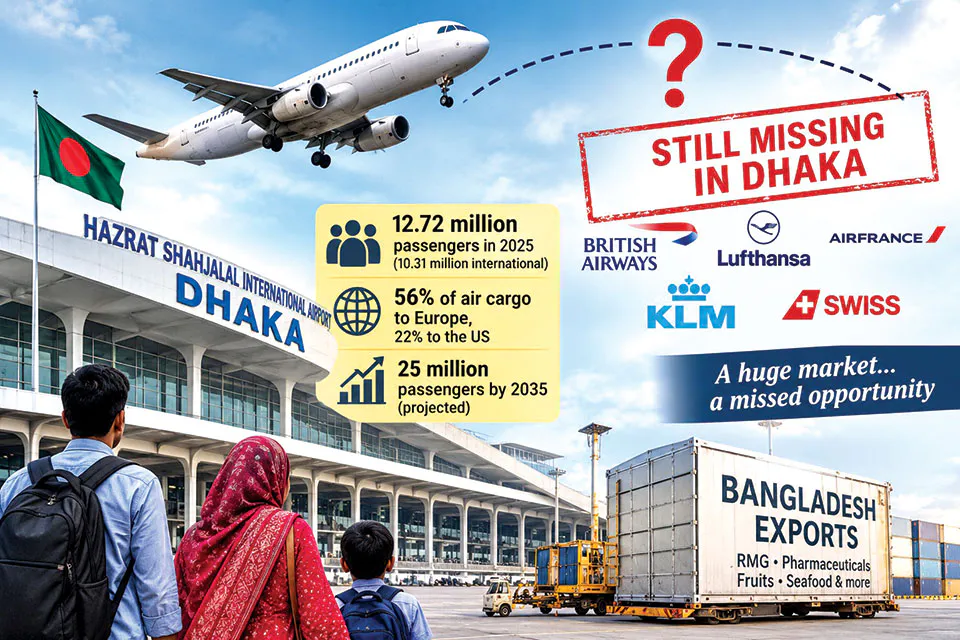
trade. HSIA handled approximately 12.72 million passengers in 2025, including
10.31 million international passengers.
Despite
this growth, national carriers Biman Bang-ladesh Airlines and US-Bangla
Airlines continue to face strong competition from foreign operators. In 2025,
the two Bangla-deshi airlines together carried approximately 40 percent of
HSIA's international passengers, leaving around 60 percent to 38 foreign
airlines.
Middle
Eastern carriers, in particular, have established strong positions by using
their respective hubs to connect Bangladeshi passengers with Europe, North
America, Africa and other destinations.
Industry
projections indicate that Bangladesh's passenger market could reach 25 million
by 2035, although JICA's specific projection for Dhaka's international traffic
is 20 million. Such growth should make the country an attractive destination
for additional international operators.
Yet,
the absence of major Western European carriers raises questions about why
Bangladesh has not been able to translate its market potential into greater
direct international connectivity.
Decline
of direct European airline presence
Bangladesh
once enjoyed direct European connectivity through British Airways, which
operated between Dhaka and London for more than three decades following the
country's independence. However, BA suspended its services in March 2009,
citing commercial reasons.
KLM
Royal Dutch Airlines also operated services connecting Amsterdam, Dubai and
Dhaka in the early 1990s, although its presence was relatively short-lived.
The
departure of British Airways in 2009 marked a significant setback for
Bangladesh's direct connectivity with Western Europe. Since then, no major
Western European airline has established scheduled passenger operations to
Dhaka.
Turkish
Airlines subsequently entered the market, launching its Dhaka-Istanbul services
in December 2010. It has since become an important European-based carrier
connecting Bangladesh with Europe and other international destinations through
its Istanbul hub.
However,
Istanbul-based connectivity should not be confused with the presence of major
Western European network airlines operating their own services to Bangladesh.
Biman
Bangladesh Airlines has maintained European connections through its own
operations, including Rome and London services. Nevertheless, the absence of
airlines such as British Airways, Lufthansa, Air France and KLM means that
passengers remain heavily dependent on connecting services through foreign
hubs.
The
situation is even more disappointing in the North American market, where no
American airline operates scheduled passenger flights to Dhaka, despite the
substantial Bangladeshi diaspora in the United States and Canada.
Enormous
expatriate passenger market
Millions
of Bangladeshis live and work abroad, generating substantial and recurring
international travel demand. While the Middle East remains the largest overseas
employment destination, Bangladesh also has well-established communities
throughout the United Kingdom, Italy, France, Germany, Spain, Portugal, Greece,
the Netherlands and Scandinavian countries.
Similarly,
the United States and Canada represent important markets for family visits,
business, education and tourism.
In
the absence of direct services by major Western European and American carriers,
passengers largely depend on connecting flights through Dubai, Doha, Abu Dhabi,
Istanbul, Singapore, Kuala Lumpur and other foreign hubs.
This
dependence increases journey times, often adds to travel costs and leaves
passengers with limited choices. More direct connectivity would facilitate
travel, strengthen commercial relations, encourage tourism and improve
people-to-people exchanges.
For
European and American airlines, the sizeable expatriate population, combined
with growing business and leisure travel, should offer a compelling market
proposition.
Air
cargo : perhaps strongest commercial argument
Beyond
passenger traffic, Bangladesh's air cargo export potential offers an equally
compelling reason for European and American airlines to reconsider the market.
As
one of the world's leading ready-made garment (RMG) exporters, Bangladesh has
enormous trade volumes destined for Europe and North America. Its air freight
requirements are driven primarily by time-sensitive garment shipments,
alongside pharmaceuticals, fresh vegetables, fruits, seafood, machinery and
other high-value products.
According
to International Air Express Association of Bangladesh data reported in March
2026, Europe accounts for approximately 56 percent of Bangladesh's air cargo
exports, while the United States accounts for around 22 percent. Together,
these markets represent nearly four-fifths of the country's air cargo export
destinations.
The
scale of this opportunity becomes even more apparent from the fact that
Bangladeshi garment exporters shipped more than 34,900 tons of apparel, worth
approximately USD 462 million, through Indian airports between January 2024 and
March 2025, reaching 36 countries. Major destinations included the United
States, Germany and France.
This
represents a significant loss of potential cargo-handling, airline and airport
revenue for Bangladesh.
The
introduction of direct services by major European and American airlines could
provide additional cargo capacity, reduce dependence on transit hubs and
improve delivery times for exporters.
Potential
destinations include London, Frankfurt, Paris, Amsterdam, Rome, Milan and
Zurich in Europe, and New York, Chicago, Washington, Los Angeles and Toronto in
North America.
Passenger
aircraft with belly-hold cargo capacity could provide an economically viable
starting point, while dedicated freighter operations could be developed as
cargo volumes increase.
Bangladesh
has already demonstrated the viability of direct cargo operations. In April and
May 2025, dedicated freighters operating from Sylhet's Osmani International
Airport carried ready-made garments directly to Spain, with individual
shipments of approximately 58-60 tons.
Emirates
SkyCargo's announcement of a dedicated weekly freighter service to Dhaka from
April 2026 further reflects the growing demand for Bangladesh-origin cargo.
Clearly,
the potential exists. What is required is adequate capacity, competitive
pricing and reliable cargo-handling infrastructure.
Why
major Western airlines
staying away?
The
absence of major Western European and American airlines from Dhaka cannot be
attributed to a lack of market demand alone. Several operational, commercial
and policy-related factors may have contributed to this situation.
High
airport charges, fuel costs, ground-handling expenses, taxation, operational
inefficiencies and regulatory uncertainties can adversely affect route
profitability.
Bangladesh
has also faced longstanding challenges concerning cargo screening,
cargo-terminal capacity and ground-handling services. Such shortcomings can
undermine the confidence of international operators, particularly those
handling significant volumes of high-value cargo.
Airport
infrastructure is another critical consideration. The government must ensure
that the Third Terminal at HSIA becomes fully operational with internationally
competitive passenger and cargo facilities.
Equally
important are predictable regulatory policies, internationally recognized
aviation safety and security standards, efficient customs procedures and
competitive operating costs.
Airlines
make commercial decisions based on route economics, aircraft utilization,
passenger yields, cargo revenue and the overall operating environment.
Bangladesh must therefore address these considerations if it wishes to attract
new operators.
Time
for proactive airline attraction strategy
Bangladesh
cannot continue to depend so heavily on Middle Eastern and Asian airlines for
international connectivity, particularly when its major passenger and export
markets are located in Europe and North America.
The
Ministry of Civil Aviation and Tourism, together with the Civil Aviation
Authority of Bangladesh (CAAB), should develop a dedicated international
airline attraction program. This should include identifying prospective Western
European and North American carriers and approaching them with comprehensive
passenger and cargo market studies.
Rather
than waiting for airlines to express interest, the authorities should
proactively engage with their route-planning and commercial departments,
presenting the business case for operating to Dhaka.
Competitive
airport charges, improved ground-handling services, route-development support,
joint marketing initiatives and a predictable regulatory environment should
form part of the strategy.
Bangladesh
should also explore the possibility of developing Dhaka as a regional cargo
gateway, leveraging its strong export base and geographical position.
Attracting
foreign airlines does not mean undermining Biman or US-Bangla Airlines. On the
contrary, increased competition would encourage better services, more
competitive fares and improved connectivity. It would also create opportunities
for Bangladeshi carriers to expand their own networks and strengthen their
competitiveness.
After
55 years of independence, Bangladesh should not remain so dependent on foreign
aviation hubs to connect its people and exports with the world's major economic
centers.
The
country has the passenger base, the expatriate market and the export potential
to attract some of the world's leading airlines. What is missing is a
determined national strategy, a competitive operating environment and a
proactive approach to converting this enormous potential into reality.
The
absence of major Western European airlines from Dhaka is not simply a
connectivity gap; it is a missed opportunity that Bangladesh can no longer
afford to overlook.