


US-Bangla's upcoming Aviation Academy to address industry-wide skills gap

Dhaka
: US-Bangla Airlines has completed 12 years of operations, growing from two
aircraft to a fleet of 25. Now, as it prepares to add 21 more aircraft by the
end of 2027, the airline's next challenge is not fleet size - it is building
the workforce to fly and maintain it.
Kamrul
Islam, General Manager of Public Relations at US-Bangla Airlines, said this
while talking to The Bangladesh Monitor about the airline's upcoming Aviation
Academy at his office in the capital recently.
Fleet expansion outpaces training capacity
 Kamrul Islam
Kamrul
added US-Bangla currently flies to 14 international destinations across 10
countries, in addition to its domestic network. In July, the airline announced
plans to add 21 more aircraft, including 15 Boeing 737-8 and six 737-800 jets,
by December 2027.
The
growth will require a steady pipeline of pilots and aircraft maintenance
engineers, he said, professionals who cannot be trained overnight due to strict
regulatory and certification requirements.
The
core problem, according to Kamrul, is that Bangladesh's aviation industry has
expanded faster than its training infrastructure. The country still does not
have a comprehensive aviation academy, despite 55 years of independence.
Broader
mandate than pilots, engineers
To address the gap, US-Bangla is planning a full-scale Aviation Academy covering not just pilots and engineers but also cabin crew, customer service, security, catering, sales, reservations, and ground operations.
Specialized
functions such as revenue management, revenue accounting, engineering stores,
and branding and public relations would fall under the academy's scope as well,
Kamrul said, alongside training for aircraft cleaning staff.
He
mentioned the academy's location remains under discussion. Dhaka is attractive
for accessibility, but Hazrat Shahjalal International Airport is already
congested, so flight-training infrastructure may need government support to
materialize.
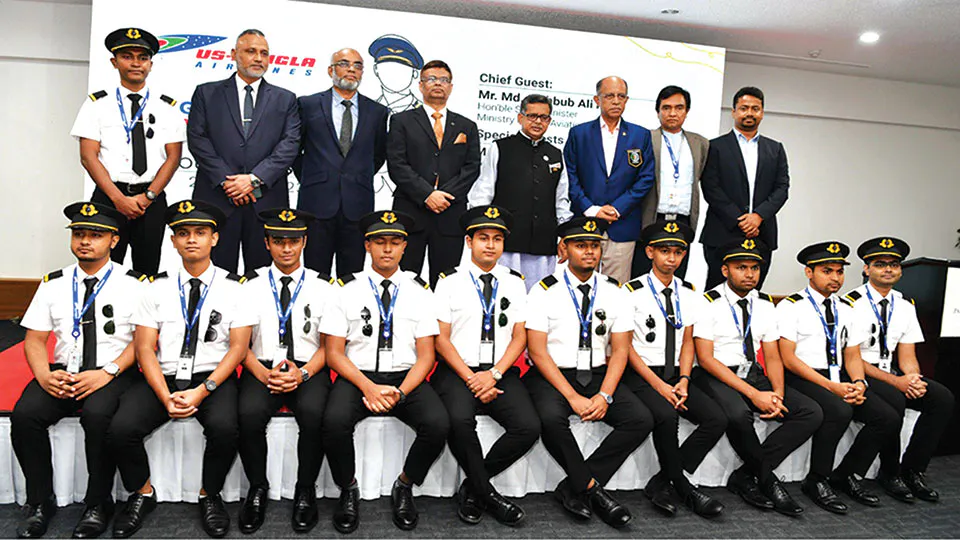
Cadet
programs already underway
Over
the past three years, US-Bangla has sent 28 cadet pilots to the United States
for ATPL and CPL training; all have returned and joined the airline as first
officers, Kamrul said.
Separately,
18 aircraft maintenance engineers were sent to Thakur Institute of Aviation
Technology in India, with 12 already back at work and the remaining six
expected to return soon.
He
noted the airline now plans to recruit around 200 cadet pilots and 100
maintenance engineers, continuing to train some abroad while building domestic
capacity through the planned academy.
Foreign
currency, wider economic case
Training locally would reduce the outflow of foreign currency currently spent sending staff abroad, Kamrul said. Conversely, Bangladeshi professionals trained to international standards could work for foreign carriers, generating remittance-like earnings.

He
compared the potential to Bangladesh's migrant workforce, roughly 15 million
strong, and argued that aviation and tourism, which together contribute about
three percent to GDP, could reach six to seven percent with a skilled
workforce, matching India's contribution and approaching Sri Lanka's near nine
percent.
Toward
aviation group
Kamrul
expressed US-Bangla's ambitions extend beyond a single airline to an
"Aviation Group," combining its existing full-service model with a
possible low-cost-carrier offering for price-sensitive leisure travelers.
The
group would also expand into maintenance, repair, and overhaul (MRO) services,
with potential hubs in Sylhet and Chattogram, alongside cold-chain
infrastructure to support cargo and transshipment near airports.
Catering
and ground-handling services could be extended to some of the roughly 35
foreign airlines operating in Bangladesh, he added, creating new revenue
streams as the Third Terminal at Hazrat Shahjalal International Airport comes
online.
No
fixed timeline, strong youth interest
Kamrul
declined to give a launch date for the academy, saying only that US-Bangla
wants to move forward as early as possible given its fleet and route expansion
plans.
He
claimed growing interest among Bangladesh's Generation Z in aviation careers
and said the academy aims to offer a structured path from selection and
training to certification and employment.
Kamrul
concluded the airline hopes the government will provide policy and regulatory
support as the project develops, calling it a venture that would benefit not
just US-Bangla but Bangladesh's wider aviation industry.