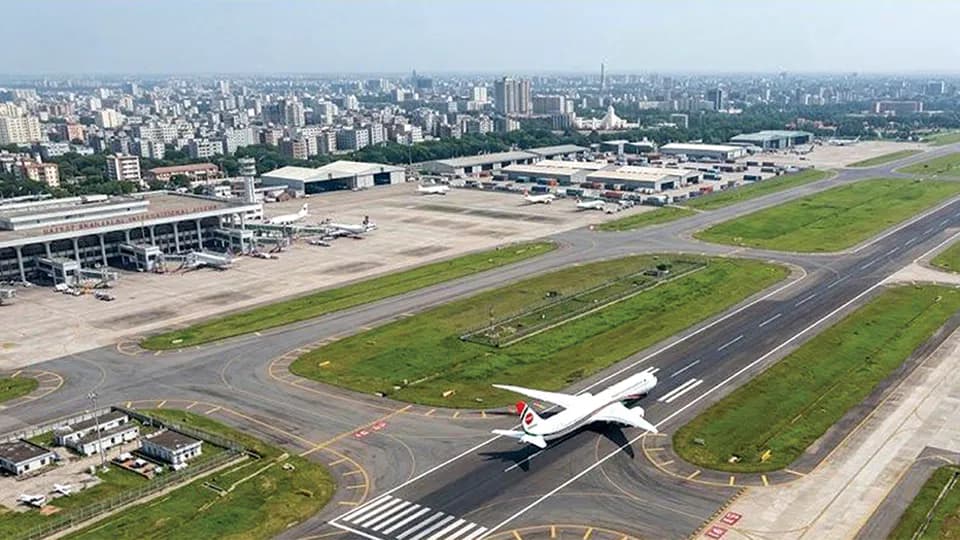
Dhaka's aviation paradox : Can single runway support airline boom?
Dhaka : Imagine it is 8:00 pm at Dhaka's Hazrat Shahjalal International Airport (HSIA). The apron is full. Aircraft are waiting for pushback. More flights are approaching Dhaka and entering holding patterns overhead. The departure queue continues to lengthen. Suddenly, an aircraft suffers a tire failure, runway excursion, or other incident upon landing. The runway is closed. With no second commercial runway available, the entire airside operation comes to an immediate halt. Departing flights are stranded on the ground, arriving aircraft are forced into holding patterns or diverted elsewhere, and airports across the country begin preparing for unscheduled arrivals. This is not a far-fetched scenario. It is a realistic illustration of the operational vulnerability facing Bangladesh's aviation sector as it enters a period of unprecedented growth. New era of aviation growth Bangladesh's aviation industry is entering one of the most significant expansion phases in its history. Biman Bangladesh Airlines has committed to acquiring 25 new aircraft while also exploring short-term leased capacity to meet immediate demand. US-Bangla Airlines plans to add 21 Boeing aircraft by 2027. Air Astra and NOVOAIR continue to expand their operations, while the government is actively encouraging foreign airlines to increase frequencies and launch new services to Bangladesh. Such growth should be welcomed. More aircraft means greater connectivity, increased competition, expanded tourism opportunities, new employment, and stronger economic activity. Improved air connectivity is essential for supporting trade, investment, tourism, and the mobility needs of a rapidly developing economy. Yet the growth of airline fleets inevitably raises a critical question: Can Hazrat Shahjalal International Airport accommodate this expansion with a single commercial runway? The inauguration of the Third Terminal marks a major milestone for Bangladesh aviation. The new facility significantly increases passenger-processing capacity and adds much-needed aircraft parking positions and apron space. However, passenger-handling capacity and runway capacity are two fundamentally different issues. A modern terminal can process millions of passengers annually, but every aircraft still requires access to the same runway for take-off and landing. That runway remains the airport's ultimate bottleneck. Because the western side of HSIA is occupied by a Bangladesh Air Force base and there are no immediate plans for relocation, the prospect of constructing a second commercial runway at Dhaka remains highly uncertain. For all practical purposes, Bangladesh must plan on the assumption that Dhaka will continue operating as a single-runway airport for the foreseeable future. This reality makes efficient utilization of existing infrastructure absolutely critical. Runway challenge The effects of runway constraints are already visible. Domestic flights with airborne times of barely 20 minutes can occasionally spend an equivalent amount of time waiting in departure queues during peak periods. As aircraft numbers increase, those delays will inevitably grow. A 20-minute delay could become 30. Thirty minutes could become 40. The result would be a situation where aircraft spend almost as much time waiting to depart as they do, flying to their destination. For airlines, this means increased fuel consumption, reduced aircraft utilization, longer crew duty periods, and lower schedule reliability. For passengers, it means delays, missed connections, and a diminished travel experience. Every additional aircraft movement consumes a portion of the runway's finite capacity. While fleet expansion creates opportunities, it also intensifies pressure on an already constrained infrastructure system. Parking stands not the whole answer The expansion of apron and parking facilities under the Third Terminal project is undoubtedly welcome. Yet aircraft parking capacity is only one part of the equation.Every aircraft requires not only a parking stand but also efficient access to and from that stand. If taxiways become congested, pushbacks are delayed, or aircraft movements become difficult to coordinate, operational bottlenecks can quickly spread throughout the entire airside environment. The true measure of airport capacity is therefore not simply how many aircraft can land and depart, but how efficiently those aircraft can be parked, serviced, turned around, and returned to operation. Without efficient airside management, additional parking stands may simply create more space for aircraft to wait. Can Chattogram, Sylhet provide relief? In the longer term, Chattogram and Sylhet must become part of the national aviation solution. Biman Bangladesh Airlines has previously operated international services originating from these cities, and revisiting such initiatives may be worthwhile as fleet capacity grows. US-Bangla has also expressed ambitions to develop multiple operational hubs within Bangladesh. However, expectations should remain realistic. Neither Chattogram nor Sylhet currently possesses the infrastructure, aircraft parking capacity, ground-handling capability, customs resources, or passenger-processing facilities required to absorb a substantial increase in international traffic overnight. These airports can certainly help distribute traffic more effectively in the future, but they require further development before they can function as major alternatives to Dhaka. Resilience question Capacity is only one aspect of the discussion. Resilience may be even more important. A single-runway airport is inherently vulnerable to disruption. Any incident requiring temporary runway closure - a disabled aircraft, technical malfunction, runway excursion, accident, or emergency response - can bring the entire commercial operation to a standstill. With two independent runways, traffic can often be transferred to the alternate runway. With only one runway, there is no such flexibility. As Bangladesh's aviation sector grows, the consequences of a runway closure become increasingly severe. Dozens of flights could be delayed, diverted, or cancelled. Aircraft could be forced to hold for extended periods or divert to alternative airports. The resulting disruption could extend beyond a single airline and affect the country's entire air transport network. For this reason, airport capacity should be measured not only by throughput but also by resilience. Operational improvements cannot wait While long-term infrastructure solutions remain challenging, significant improvements can still be achieved through better operational management. Several initiatives deserve serious consideration: Implementation of Airport Collaborative Decision Making (A-CDM) systems to improve coordination among airlines, air traffic control, airport operators, and ground handlers. Reduction of Runway Occupancy Time (ROT) through more efficient use of rapid-exit taxiways and improved operational procedures.Enhanced departure sequ-encing and pushback management.Better coordination of apron activities to minimize congestion.More effective utilization of off-peak operating periods.Evaluation of Level 3 airport slot coordination if demand consistently exceeds available capacity. A coordinated and transparent slot-allocation system would not create additional runway capacity, but it could help ensure that existing capacity is utilized more efficiently. Fleet growth must be matched by airport planning Bangladesh should not slow the growth of its aviation sector. The country needs more aircraft, more destinations, and greater connectivity with the global economy. However, fleet planning and airport planning cannot be treated as separate exercises. Before airlines introduce significant additional capacity, stakeholders must address several fundamental questions: Where will these aircraft operate? When will they operate? Where will they park? Can the runway accommodate the additional movements? And perhaps most importantly, what happens if the runway becomes unavailable for several hours? These are not theoretical questions. They are operational realities that require answers before congestion evolves into a systemic problem. Real challenge The exciting reality is that Bangladesh's aviation industry is finally thinking big. Airlines are investing. Passenger demand continues to grow. International carriers are expanding their presence. The Third Terminal is nearing full operational readiness. All of these developments are positive. Yet aviation growth is sustainable only when airport infrastructure and operational capacity grow alongside airline fleets. Otherwise, more aircraft may simply result in more aircraft waiting on the ground. The challenge facing Bangladesh today is no longer merely how to put more aircraft into the sky. It is how to ensure those aircraft can operate safely, efficiently, predictably, and reliably within the infrastructure available. The aircraft are coming. More flights are coming. More passengers are coming. The question is whether the airport system is prepared to handle them. Because the future success of Bangladesh's aviation sector may ultimately depend not on how many aircraft airlines can acquire, but on how effectively the nation manages the runway, apron, and operational capacity it already possesses.